
That is where an AI consultant comes in.
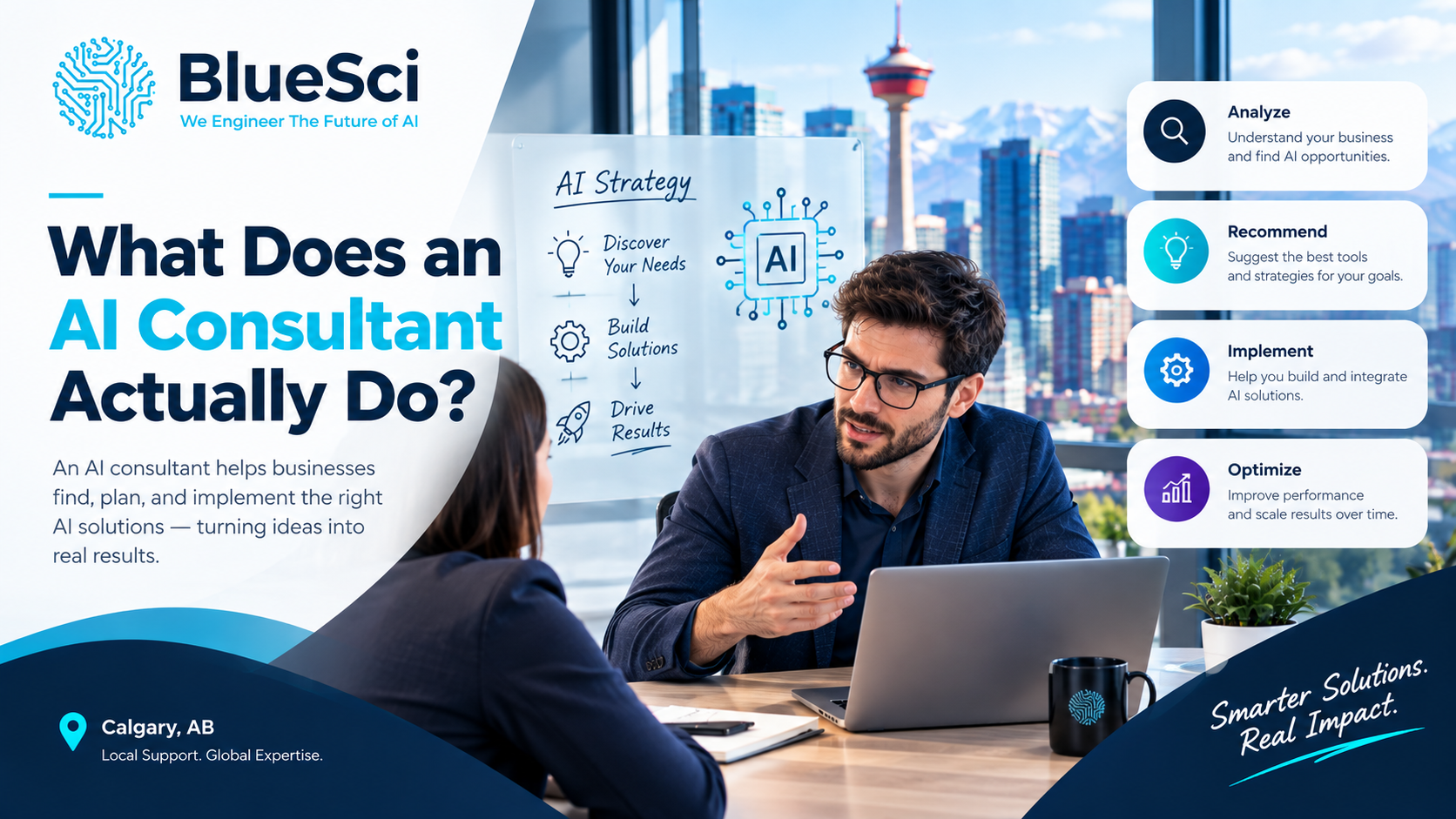
An AI consultant helps a business identify practical opportunities for artificial intelligence, evaluate whether those opportunities are technically and commercially realistic, develop an AI strategy, select appropriate technologies, and guide AI solutions from concept through implementation.
In other words, an AI consultant should not simply tell you to “use AI.” They should help answer a much more valuable question:
Where can AI create measurable value in your business, and what is the most practical way to get there?
Quick Answer: What Does an AI Consultant Actually Do?
An AI consultant connects business problems with practical AI solutions. Their work can include assessing your current processes and data, identifying useful AI opportunities, prioritizing use cases, selecting technology, developing an AI roadmap, supporting prototypes and integrations, establishing governance, training employees, and measuring whether the solution produces the intended business outcome.
The exact work depends on the organization. A company automating document processing has very different requirements from a company building an internal AI assistant or using machine learning to analyze operational data.
That is why effective AI Consulting & Strategy normally begins with the business problem rather than a particular AI product.
1. They Learn How Your Business Actually Works
Before recommending an AI solution, an AI consultant needs to understand the organization.
That means looking beyond the question, “Where can we add AI?”
Instead, the consultant may investigate how employees complete repetitive tasks, where information is manually transferred between systems, which processes consume significant staff time, where customers experience delays, what decisions depend heavily on data, and where existing technology creates bottlenecks.
For example, a business might initially ask for an AI chatbot. After examining the workflow, however, the bigger opportunity could be automating how incoming customer requests are classified, summarized, routed, and entered into existing systems.
The technology should follow the business problem—not the other way around.
2. They Identify Practical AI Use Cases
Not every business process needs artificial intelligence.
Sometimes conventional automation, better system integration, or a workflow redesign can solve the problem more simply. A useful part of AI consulting is therefore determining where AI is appropriate and where it is not.
Potential business AI use cases can include:
- Customer-service assistants and internal knowledge assistants
- Document classification and information extraction
- Workflow automation
- Forecasting and predictive analytics
- Intelligent search across company information
- Summarizing documents, meetings, or communications
- Sales and operational analytics
- Automated reporting
- AI-assisted knowledge workflows
- Connecting AI capabilities to existing business systems
If repetitive workflows are the main problem, Intelligent Automation & Process Optimization may become part of the solution.
The objective is not to create the longest possible list of AI ideas. It is to identify opportunities that are worth investigating and that can be connected to a meaningful business outcome.
3. They Prioritize AI Opportunities
Finding 20 possible AI use cases does not mean a company should build 20 AI solutions.
An AI consultant helps prioritize them.
That assessment can consider expected business value, implementation complexity, data availability, security requirements, integration requirements, cost, operational risk, and how easily success can be measured.
This helps separate an interesting AI experiment from a project capable of producing useful business outcomes.
A relatively focused project with a clearly defined problem can sometimes be a more practical starting point than an ambitious transformation involving multiple departments and systems at once.
4. They Assess Your Data and Existing Systems
AI depends heavily on data, but having a large amount of data does not automatically mean that data is ready for AI.
An AI consultant may need to determine what information exists, where it is stored, who can access it, how reliable it is, whether important information is missing, and whether different systems can communicate with each other.
This can uncover an important reality:
Sometimes an AI project is actually a data or systems-integration project first.
If critical information is fragmented across spreadsheets, databases, cloud applications, and disconnected business systems, those foundations may need attention before an AI solution can work effectively.
If you want to understand this part in more detail, read our guide: What Is Systems Integration and Why Does It Matter?
This is one reason AI strategy should be connected to the wider technology environment rather than treated as an isolated initiative.
5. They Decide What Type of AI Solution Makes Sense
Once the problem and available data are understood, the consultant can evaluate possible technical approaches.
That does not always mean building a custom AI model.
Depending on the project, the right solution could involve an existing AI platform, a large language model, an API, machine learning, retrieval-based AI, workflow automation, a custom application, or a combination of technologies.
An AI consultant should be able to explain why a particular approach fits the business problem rather than choosing a technology simply because it is popular.
Technology selection should also consider how a solution fits the organization’s existing data, systems, users, security requirements, and budget.
6. They Build an AI Roadmap
A good AI idea still needs a realistic implementation plan.
An AI roadmap turns a broad objective into a sequence of practical steps.
A simplified process might look like this:
Business Problem → Requirements → Data Assessment → Prototype → Testing → Integration → Deployment → Adoption → Measurement
The roadmap should also identify dependencies.
If a proposed AI system requires information from several existing platforms, integration work may need to happen before deployment. If employees will rely on the system for important workflows, testing and human oversight may require additional attention.
BlueSci’s AI Strategy & Roadmap Development service is designed around this type of structured process, moving from readiness assessment and opportunity identification toward a phased implementation roadmap.
What Does an AI Consultant Actually Do?
7. They Build or Guide a Proof of Concept
Going directly from an idea to a company-wide AI deployment can introduce unnecessary risk.
A proof of concept or prototype provides a smaller environment for answering important questions:
- Can the AI perform the required task?
- Is the available data sufficient?
- Can the solution connect to the necessary systems?
- Are the outputs useful?
- Where does human review need to remain?
- Does the potential business value justify continuing the project?
A prototype is therefore not simply a demonstration. It can be a practical way to test assumptions before committing to a larger implementation.
8. They Help Integrate AI With Existing Business Systems
This is one of the most important—and sometimes overlooked—parts of AI consulting.
An AI tool sitting by itself may provide limited business value. The bigger opportunity often appears when AI can work with the systems employees already use.
That could mean connecting AI with a CRM, ERP, document-management platform, internal database, customer portal, communication system, or another business application.
For example, an AI system might analyze an incoming request, retrieve relevant information, summarize the issue, and pass structured information into an existing workflow.
That requires more than an AI model. It requires systems integration.
Our article What Is Systems Integration and Why Does It Matter? explains why connected systems and data can be an important foundation for automation and AI projects.
9. They Think About AI Security, Privacy, and Governance
Giving an AI system access to business information requires careful planning.
An AI consultant should help the organization consider what information the AI can access, which users should have access, how outputs are reviewed, and what controls may be required.
AI governance becomes increasingly important as AI moves from experimentation into everyday business operations.
For organizations developing their approach to AI risk and governance, the NIST AI Risk Management Framework provides a structured framework for managing risks associated with AI systems.
A business should know where AI is being used, what it is being used for, and where human responsibility remains necessary.
The goal should not be uncontrolled automation. It should be useful automation with appropriate oversight.
10. They Help Employees Actually Use the AI Solution
A technically impressive AI system has little value if employees avoid it or do not understand how to use it.
AI adoption therefore includes people as well as technology.
Consultants may help establish workflows, document processes, train employees, and define when users should rely on AI versus when a task requires human review.
This is particularly important with generative AI because outputs may still require verification and appropriate human judgment.
For organizations that need to develop practical AI skills across their workforce, BlueSci also provides AI Training & Workforce Development.
Successful AI adoption means employees understand both the capabilities and the limitations of the system.
11. They Measure Whether the AI Is Actually Working
Deployment should not be the end of an AI project.
Businesses need to determine whether the solution is producing the expected results.
The appropriate measurements depend on the original objective.
If the goal was reducing repetitive administrative work, the business might measure time saved. If the goal was improving customer-response workflows, it might examine response times or workload. If the project involved document processing, the organization could measure processing time and how much human correction is still required.
The important principle is simple:
Measure the AI against the business problem it was supposed to solve.
Without that connection, businesses can end up measuring technical activity instead of actual business value.
AI Consultant vs. AI Developer: What Is the Difference?
The roles can overlap, but they are not identical.
An AI developer or engineer is generally more focused on building the technical solution.
An AI consultant usually has a broader role: understanding the business problem, identifying appropriate AI opportunities, evaluating feasibility, developing strategy, and helping coordinate the path from business requirements to implementation.
Some AI consulting engagements include hands-on technical development, while others involve consultants working alongside internal developers or external implementation teams.
For a business, the important question is less about the job title and more about whether the provider can connect business objectives, data, systems, people, and implementation.
What Does an AI Consultant Do on a Typical Project?
Although every engagement is different, a practical AI consulting project might begin with the business explaining an operational challenge.
The consultant examines the workflow and systems involved, identifies potential AI opportunities, and evaluates the available data.
The team then selects a use case with a clear objective.
Technical requirements are defined, an appropriate AI approach is selected, and a prototype may be developed.
The prototype is tested against real business requirements. If it proves useful, the solution can then move toward integration with the organization’s systems and workflows.
Employees may need training, appropriate controls are established, and results can be monitored after deployment.
So the consultant is not simply someone who recommends an AI tool.
Problem → Opportunity → Strategy → Technology → Implementation → Business Result
When Does a Business Need an AI Consultant?
A business may benefit from AI consulting when it sees opportunities for AI but does not know where to start.
Other signs can include employees experimenting with different AI tools without a wider strategy, important workflows containing repetitive manual work, information being spread across multiple systems, or the organization having an AI idea without knowing whether it is technically realistic.
You may also have an existing AI experiment that works as a prototype but now needs to become a more structured business solution.
Businesses at an earlier stage can also use an AI Readiness Assessment to examine factors such as data, systems, and organizational preparedness before committing to a larger initiative.
You do not necessarily need an enormous “AI transformation.” A clearly defined, high-value use case can be a more practical starting point.
What Should You Ask an AI Consultant Before Hiring Them?
The conversation should go beyond asking which AI platforms they know.
Useful questions include:
- How will you identify worthwhile AI use cases in our business?
- How will you evaluate our existing data and systems?
- How do you decide whether AI is actually necessary?
- Can you support integration and implementation?
- How do you approach AI security and governance?
- How will employees be prepared to use the solution?
- How will success be measured?
- What happens after a prototype succeeds?
Be cautious when a proposed solution appears before the consultant understands the business problem.
AI consulting should begin with discovery.
Does Every Business Need Custom AI?
No.
One of the biggest misconceptions about AI consulting is that every business needs to build its own AI model.
In many situations, existing AI models and platforms can provide the core AI capability while custom development focuses on the company’s data, workflows, integrations, and user experience.
The valuable part may not be inventing a new model.
It may be applying existing AI effectively to a specific business process.
How BlueSci Approaches AI Consulting
At BlueSci, AI consulting starts with understanding the business objective, current systems, data, and team before deciding what technology should be implemented.
BlueSci’s AI Consulting & Strategy Advisory combines technical assessment with business context to identify AI opportunities and build an implementation direction around what the organization can realistically execute.
Depending on the requirements, the next stage may involve AI Strategy & Roadmap Development, Intelligent Automation & Process Optimization, system integration, or workforce training.
Because AI increasingly interacts with existing applications, data, workflows, and infrastructure, the surrounding technology environment matters too.
The objective is not simply to add AI.
It is to determine where AI makes sense and build a practical path from opportunity to implementation.
Frequently Asked Questions About AI Consultants
What does an AI consultant actually do?
An AI consultant helps businesses identify useful AI opportunities, assess data and technology requirements, develop an AI strategy, select appropriate solutions, and guide projects from initial concept toward implementation and adoption.
Does an AI consultant actually build AI?
Sometimes. The scope varies by consultant and project. Some consultants focus primarily on strategy, while others also support prototypes, development, automation, integration, and deployment.
What is the difference between AI consulting and AI development?
AI consulting generally begins with the business problem and determines what should be built and why. AI development focuses more directly on creating the technical solution. Many projects require both.
Can an AI consultant automate business processes?
Yes, when AI is appropriate for the process. However, some workflows may be better solved using traditional automation or systems integration rather than AI.
Does my business need its own AI model?
Not necessarily. Many business applications can use existing AI models and platforms combined with the company’s own workflows, information, and systems.
What should an AI consultant look at first?
The starting point should normally be the business problem, existing workflow, available data, current systems, and the result the organization wants to achieve—not a particular AI product.
How do you know if an AI project is successful?
Success should be connected to the original business objective using relevant measurements such as time saved, reduced manual work, faster processing, improved workflow efficiency, or another defined operational outcome.
Can small businesses work with an AI consultant?
Yes. The scope of an AI engagement can be adjusted to the organization’s size, requirements, and level of AI readiness. A smaller business may begin with one clearly defined workflow rather than a large organization-wide AI program.
AI Consulting Is About More Than Choosing an AI Tool
The most important answer to “What does an AI consultant actually do?” is that their job should connect AI technology to a real business objective.
That means understanding the problem before selecting technology, determining whether AI is actually appropriate, evaluating data and existing systems, creating a realistic roadmap, testing the idea, supporting integration, preparing employees, and measuring what happens after deployment.
Businesses do not need AI simply because AI is available.
They need a clear reason to use it and a practical plan for turning that opportunity into something useful.
Related BlueSci Resources
- What Is Systems Integration and Why Does It Matter? — Learn why connected systems and data can be an important foundation for automation and AI projects.
- BlueSci AI Consulting Blog — Explore practical articles on AI strategy, automation, data, and implementation.
Related AI Services
- AI Consulting & Strategy Advisory
- AI Strategy & Roadmap Development
- Intelligent Automation & Process Optimization
- AI Training & Workforce Development
- AI Readiness Assessment
Not Sure Where AI Fits Into Your Business?
Talk with BlueSci about your workflows, data, systems, and business goals. We can help identify practical AI opportunities and determine what a realistic path to implementation could look like.
Start with the business problem. Then determine where AI makes sense.
Related Articles
Turn this insight into an implementation plan.
Book a free consultation with BlueSci.